Are You Assessing Your Clients for Polyvictimization?
Families rarely experience harm in a single, isolated way. Many caregivers and children live through multiple, overlapping forms of victimization - over time, and often without ever naming it as such. Understanding the full context of harm is a critical step toward healing. In partnership with Johns Hopkins, we created this toolkit as a healing-centered support for providers working alongside families impacted by polyvictimization.
Providers can use this guide and conversation cards available in English and Spanish as support tools.
INSIDE THE TOOLKIT:
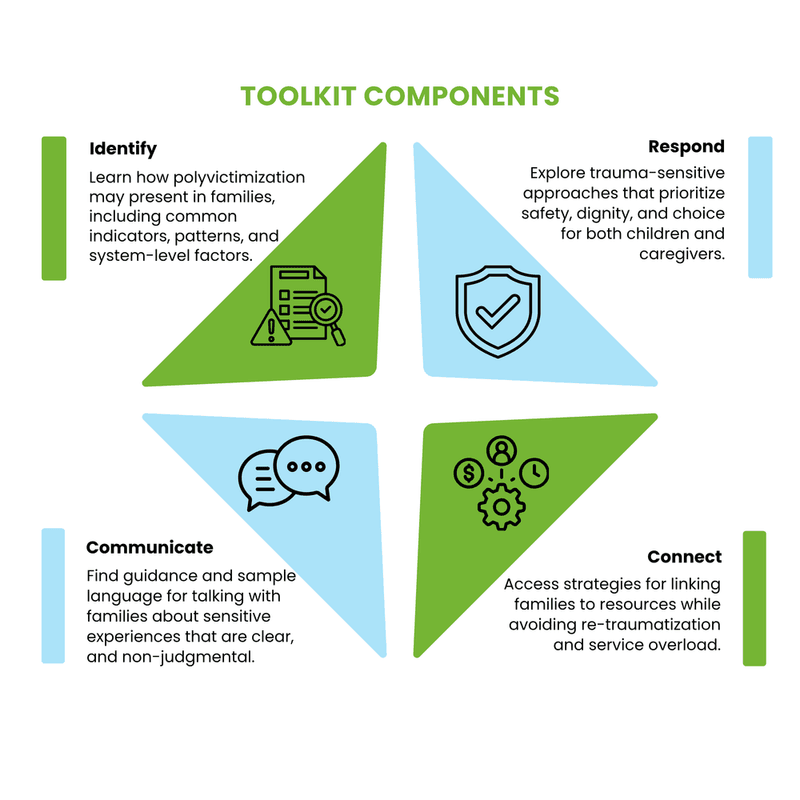
The guide is a comprehensive 18-page digital booklet that is designed to be practical, flexible, and user-friendly. It can be used when preparing for a conversation, responding to a moment, or building long-term support plans.
The following research from those who have advanced this field helped inform this project. We are grateful for all their contributions and encourage you to learn more.
1. Turner HA, Ph.D., Shattuck A, Ph.D., Finkelhor D, Ph.D., Hamby S, Ph.D. Polyvictimization and youth violence exposure across contexts. Journal of adolescent health. 2016;58(2):208–214. https://pubmed.ncbi.nlm.nih.gov/26598060/. doi: 10.1016/j.jadohealth.2015.09.021.
2. Ogle CM, Caroline Harmon-Darrow, Fedina L, Nichols D, Mulford CF, Backes BL. Operational definitions of poly-victimization: A scoping review. Trauma, Violence, & Abuse. 2024;25(4):3360–3376. https://doi-org.proxy1.library.jhu.edu/10.1177/15248380241246522. doi: 10.1177/15248380241246522.
3. Ana RP, Telma CA. Risk factors of poly-victimization and the impact on delinquency in youth: A systematic review. Crime & Delinquency. 2024;70(9):2469–2487. https://doi.org/10.1177/00111287221148656. doi: 10.1177/00111287221148656.
4. DeHart DD, Moran R. Poly-victimization among girls in the justice system. Violence Against Women. 2015;21(3):291–312. https://doi-org.proxy1.library.jhu.edu/10.1177/1077801214568355. doi: 10.1177/1077801214568355.
5. Morlat PV, Alison L. Understanding “childhood poly-victimization” to help uncover abuse during child investigative interviewing: A systematic review. Frontiers in psychology. 2024;15:1395940. https://www.ncbi.nlm.nih.gov/pubmed/39351110. doi: 10.3389/fpsyg.2024.1395940.
6. ChienTi Plummer Lee, Mersky J, Marsee I, Fuemmeler B. Childhood polyvictimization and marijuana use trajectories. Dev Psychopathol. 2022;34(1). https://pubmed.ncbi.nlm.nih.gov/32958085/. doi: 10.1017/S0954579420000875.
7. Finkelhor D, Ormrod R, Turner H, Holt M. Pathways to poly-victimization. Child maltreatment. 2009;14(4):316–329. https://journals.sagepub.com/doi/full/10.1177/1077559509347012. doi: 10.1177/1077559509347012.
8. Ford JD, Grasso DJ, Hawke J, Chapman JF. Poly-victimization among juvenile justice-involved youths. Child Abuse Negl. 2013;37(10):788–800. https://www.sciencedirect.com/science/article/pii/S0145213413000227. doi: 10.1016/j.chiabu.2013.01.005.
9. Davis JP, Dworkin ER, Helton J, et al. Extending poly-victimization theory: Differential effects of adolescents’ experiences of victimization on substance use disorder diagnoses upon treatment entry. Child abuse & neglect. 2019;89:165–177. https://www.clinicalkey.com/#!/content/1-s2.0-S0145213419300298. doi: 10.1016/j.chiabu.2019.01.009.
10. Turner HA, Finkelhor D, Ormrod R. Poly-victimization in a national sample of children and youth. Am J Prev Med. 2010;38(3):323–330. https://www-sciencedirect-com.proxy1.library.jhu.edu/science/article/pii/S0749379709008538. doi: 10.1016/j.amepre.2009.11.012.
11. Feng J, Hsieh Y, Hwa H, Huang C, Wei H, Shen AC. Childhood poly-victimization and children’s health: A nationally representative study. Child Abuse & Neglect. 2019;91:88–94. https://www.clinicalkey.com/#!/content/1-s2.0-S0145213419300791. doi: 10.1016/j.chiabu.2019.02.013.
12. Turner HA, Shattuck A, Finkelhor D, Hamby S. Effects of poly-victimization on adolescent social support, self-concept, and psychological distress. J Interpers Violence. 2017;32(5):755–780. https://doi-org.proxy1.library.jhu.edu/10.1177/0886260515586376. doi: 10.1177/0886260515586376.
13. Finkelhor D, Ormrod RK, Turner HA. Poly-victimization: A neglected component in child victimization. Child Abuse & Neglect. 2007;31(1):7–26. https://www.sciencedirect.com/science/article/pii/S0145213406003346. doi: 10.1016/j.chiabu.2006.06.008.
14. Gibbs V, Hudson JL, Pellicano E. Poly-victimization of autistic adults: An investigation of individual-level correlates. Autism Research. 2023;16(12):2336–2349. https://pubmed.ncbi.nlm.nih.gov/37737378/. doi: 10.1002/aur.3031.
15. Wolfe DA. Why polyvictimization matters. J Interpers Violence. 2018;33(5):832–837. https://doi-org.proxy1.library.jhu.edu/10.1177/0886260517752215. doi: 10.1177/0886260517752215.
16. Finkelhor D, Ormrod RK, Turner HA. Polyvictimization and trauma in a national longitudinal cohort. Dev Psychopathol. 2007;19(1). https://www.proquest.com/scholarly-journals/polyvictimization-trauma-national-longitudinal/docview/201698758/se-2?accountid=11752.
17. Hamby S, Grych J. Tracing the threads of the web: The epidemiology of interconnections among forms of violence and victimization. In: The web of violence. Dordrecht: Springer Netherlands; 2012:9–27. http://link.springer.com/10.1007/978-94-007-5596-3_2. 10.1007/978-94-007-5596-3_2.
18. Finkelhor D, Ormrod RK, Turner HA. The developmental epidemiology of childhood victimization. J Interpers Violence. 2009;24(5):711–731. https://pubmed.ncbi.nlm.nih.gov/18467689/. doi: 10.1177/0886260508317185.
19. Substance Abuse and Mental Health Services Administration. SAMHSA's concept of trauma and guidance for a trauma-informed approach. 2014. https://www.nctsn.org/sites/default/files/resources/resource-guide/samhsa_trauma.pdf.
20. Cusick J. Post-secondary peer support training curriculum subtitle: Including B.C.'s peer support standards of practice. ; 2022. https://opentextbc.ca/peersupport/chapter/samhsas-six-principles-of-trauma-informed-care/.
21. Concordia University St. Paul. The 6 principles of trauma-informed care. https://online.csp.edu/resources/article/principles-of-trauma-informed-care/. Updated 2025.
22. Snively E. 6 principles of trauma-informed care. Relias Web site. https://www.relias.com/blog/6-principles-of-trauma-informed-care. Updated 2026.
23. Safe Start Center, National Resource Center for Children’s Exposure to Violence, Office of Juvenile Justice and Delinquency Prevention (OJJDP). Children exposed to violence: Tips for staff and advocates working with children: Polyvictimization. 2011. https://www.ojp.gov/library/publications/children-exposed-violence-tips-staff-and-advocates-working-children
24. Pinto-Cortez C, Pereda N, Álvarez-Lister MS. Child victimization and poly-victimization in a community sample of adolescents in northern chile. Journal of aggression, maltreatment & trauma. 2018;27(9):983–1002. https://www.tandfonline.com/doi/abs/10.1080/10926771.2017.1410748. doi: 10.1080/10926771.2017.1410748.
25. Finkelhor D, Turner H, Ormrod R, et al. Children’s exposure to violence: A comprehensive national survey. Juvenille Justice Bulletin: National Survey of Children’s Exposure to Violence Children’s Exposure to Violence. 2009. https://www.ojp.gov/pdffiles1/ojjdp/227744.pdf.